Brand identity breakdown
Adidas Logo Analysis: The Power of Three Stripes
Adidas turned a structural shoe reinforcement into one of the most recognizable patterns in branding. Three parallel strokes now encode performance, experience, and future across sportswear, streetwear, and culture.

Founded
1949
Founder
Adolf Dassler
Headquarters
Herzogenaurach, Germany
Business Scope
Sportswear, footwear, accessories
Design concept
A functional origin that became a symbol
The three stripes did not start as a logo. They began as a practical solution: Adolf Dassler added parallel leather bands to reinforce shoe uppers and improve durability. That structural role gave the pattern visibility on the product itself, and over time, the stripes became associated with the brand rather than the function.
This origin matters because it shaped how the Adidas logo behaves today. The stripes are not just a badge placed next to products—they are often part of the product. On a classic football boot or a Stan Smith sneaker, the three stripes function as structural detail, visual accent, and brand signature simultaneously.
Modern Adidas branding builds on that integration. The three-stripe Performance logo compresses the brand's philosophy into a simple geometric rhythm: performance (what the product does), experience (how it feels), and future (where it leads). Three strokes, three elements, one identity system.
Why the three stripes work
- A simple pattern that survives reproduction at any scale without losing recognition.
- A functional origin that lets the mark appear on product surfaces as part of design, not just labeling.
- A dual identity system (Performance and Originals) that lets the brand span sport and culture without diluting either.
Key takeaways
Design strengths of the Adidas identity
The Adidas logo system succeeds because it stays simple enough to be everywhere, but distinctive enough to be unmistakable. That balance is rare in a category crowded with swooshes, leaping cats, and abstract marks.
Three Stripes, Three Elements
The modern Performance logo encodes a philosophy: performance, experience, and future. Three parallel strokes compress the brand's entire worldview into a visual rhythm.
From Function to Symbol
The stripes began as a structural reinforcement on shoe uppers. Adidas turned a production necessity into one of the most recognizable patterns in visual identity.
Instant Recognition Without Complexity
A simple three-stroke pattern survives on tiny app icons, massive stadium branding, embroidery, and screenprint. No gradient, no interior detail, just silhouette.
Color Flexibility by Necessity
Because the mark works in black or white alone, it can absorb campaign colors, material finishes, and category-specific palettes without losing core recognition.
Built for Product Integration
The three stripes function as logo, product detail, and design pattern simultaneously. On a shoe sidewall, the mark is both brand signature and structural element.
A Dual Identity System
Adidas maintains two primary logos: the Trefoil for heritage and Originals, the Performance three stripes for modern sport. That duality lets the brand span culture and competition.
Color strategy
Black, white, and nothing extra
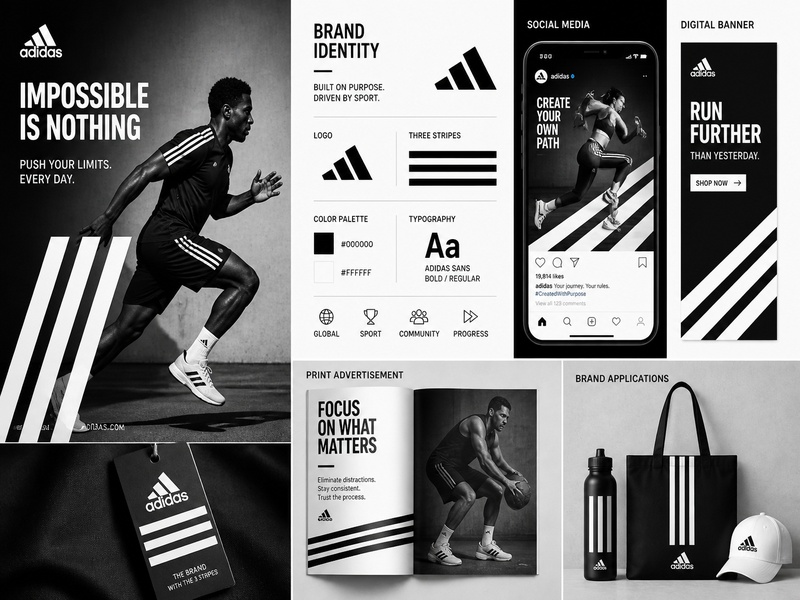
Adidas relies on a strict monochrome palette for core brand applications. Black and white provide maximum contrast, clean reproduction, and instant recognition across materials—from leather embossing to screen print to digital render.
The restraint is strategic. By avoiding a proprietary brand color, Adidas lets the three stripes adapt to product lines, seasonal campaigns, and category-specific palettes. A black mark on a white shoe looks premium. A white mark on a dark kit looks sharp. A tonal mark on an Originals sneaker feels heritage-conscious.
This flexibility is one reason the Adidas logo survives across such a wide range: football boots, basketball shoes, running gear, lifestyle apparel, and streetwear collaborations all use the same underlying mark without needing a different logo for each context.
Black
#000000
Authority, precision, and universal contrast across sportswear applications
White
#FFFFFF
Clean negative space that lets the three stripes speak without competition
Typography
A clean sans-serif wordmark that supports the stripes
The Adidas wordmark uses a bold, geometric sans-serif that feels modern without trying to be trendy. Rounded letterforms like the 'a' and 'd' give the typography a friendly, approachable quality that balances the precision of the three-stripe mark.
When the wordmark appears with the stripes, the hierarchy is clear: the geometric pattern carries the visual weight, while the typography clarifies the brand name. That separation lets Adidas use the standalone stripes in high-recognition contexts (shoes, apparel, campaigns) while reserving the wordmark for formal brand lockups and corporate communications.
Evolution
From function to icon
Adidas did not rebuild its identity every decade. It refined one strong idea—three parallel strokes—and let familiarity compound across sport, culture, and lifestyle.
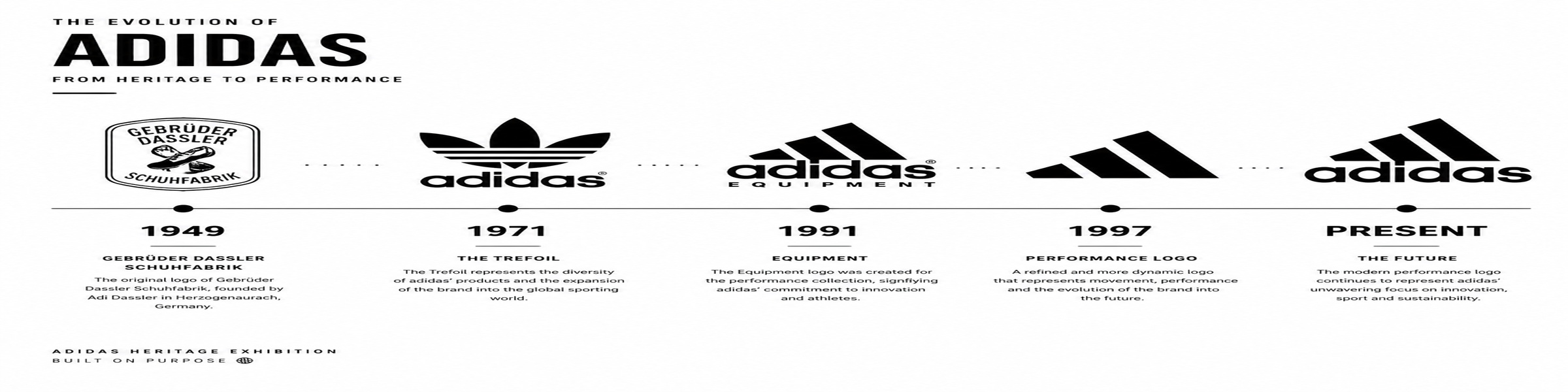
1949-1971
Adolf Dassler founded Adidas after splitting from his brother's company. The three stripes appeared early as functional reinforcement on football boots, gradually becoming a brand signature.
1972-1990
The Trefoil logo debuted for lifestyle and heritage products, representing three continents united by sport. This period cemented the three stripes as the primary performance mark while the Trefoil handled culture and lifestyle.
1991-1997
Adidas introduced the slanted three-stripe Performance logo. The diagonal angle added dynamism and distinguished modern sport products from the classic Originals line.
1997-Present
The Performance logo was refined with cleaner proportions and better digital scalability. The three stripes now appear in two primary lockups: the standalone mark and the wordmark-plus-stripes combination.
Brand context
A dual identity for sport and culture
Adidas maintains two primary logo systems: the Performance three stripes for modern sport, and the Trefoil for heritage and Originals products. That duality is unusual, but it lets the brand speak to different audiences without diluting either message.
The Trefoil represents Adidas' roots: three leaves for Europe, the Americas, and Africa, united by sport. It appears on lifestyle products, collaborations, and heritage-inspired lines. The Performance three stripes represent forward motion, competition, and technical sportswear.
Both marks are unmistakably Adidas, but they signal different things. One says "this brand has history." The other says "this brand performs." That range—from cultural credibility to athletic authority—is what makes the Adidas identity system work across streetwear and stadium alike.
Application system
A logo that becomes part of the product
The three stripes behave differently than most logos. On a shoe, they often function as a sidewall panel, a ventilation detail, or a structural accent—not just a brand badge applied after the fact. That integration is what makes Adidas branding feel natural rather than imposed.
The mark scales from embroidered logos on apparel (where thin parallel lines reproduce cleanly) to molded rubber details on footwear soles. It works in tonal applications (white-on-white, black-on-black) and high-contrast lockups (black on neon, white on dark). That flexibility comes from one trait: the three-stroke pattern is so simple that it survives almost any production method without losing recognition.
Visual evidence
The three stripes across product, time, and application
These visuals show how the Adidas logo behaves in real brand contexts: from evolution timeline to product integration.


Keep exploring
Related internal reads
Use these pages to compare Adidas' three-stripe strategy with other sportswear and minimalist identity systems.
Sources
Reference links used for factual grounding
These sources help anchor the timeline, founding facts, and design history around the Adidas identity.
Need more logo inspiration?
Ready to create a logo that performs? Get inspired by Adidas' three stripes
The Adidas identity shows how a simple pattern can encode philosophy, span sport and culture, and survive across product, packaging, and digital. Study more sportswear identities to understand what makes an athletic brand mark work.